
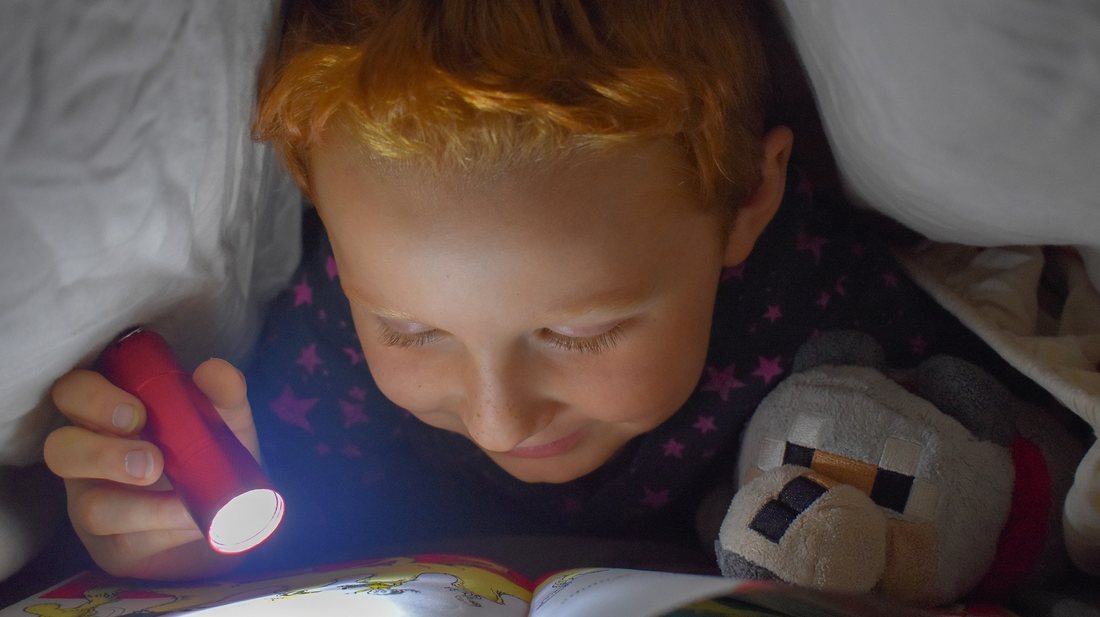
On the first page of Alice's Adventures in Wonderland, before the white rabbit ever runs past, Alice is sitting bored on a riverbank, peering into her sister's book. It has no pictures and no conversations in it, and she asks herself the question every child has asked: what is the use of a book with no pictures or conversations? Lewis Carroll put that complaint in his heroine's mouth in 1865, then spent the rest of the book answering it, because the world Alice falls into is one no illustrator handed her. She built it in her own head from words alone.
The question Alice asked, and the joke Carroll was making
Carroll knew exactly what he was doing. He opened a book that would become one of the most illustrated in the English language with a child dismissing books that have no pictures. The irony is the point. The richest imaginary world many children ever enter arrives with no images attached at all, and the mind supplies every one of them.
That is the case for the picture-free book, and it turns out to have evidence behind it that Carroll could not have known.
The children who heard a story versus the children who watched it
In the 1980s, the developmental psychologist Patricia Greenfield ran a set of experiments at UCLA that pitted radio against television. Children in the first through fourth grades were given a story that stopped partway through, some hearing it as audio only, others watching an animated version. Then the researchers asked them to finish it, and counted how many truly new elements each child invented, details that had not appeared in the story so far.
The children who had only listened produced more imaginative completions than the children who had watched. There was a carry-over as well: a child given the audio version first brought more invention even to a later television story, while a child who watched first brought less to a later radio story. The television children remembered the story's details slightly better. The radio children imagined more.
Radio versus television, first to fourth grade
Greenfield, Farrar and Beagles-Roos, UCLA, 1986 and 1988
The explanation Greenfield offered is simple. When a screen shows you the dragon, you receive it. When a voice describes the dragon, you have to make it, and the making is the mental exercise. A book with no pictures is radio you hold in your hands. Every face, room and monster has to be constructed by the reader, which is labor, and the labor is the benefit.
Picture nothing, on purpose
Read the words "a low door in the hedge, half hidden by ivy." No one has drawn it for you. Yet something appeared: a height for the door, a color for the leaves, a quality of light. You did that. A film would have handed you one version and quietly retired the muscle that just fired.
When the pictures start to get in the way
There is a second, more surprising line of evidence, and it concerns children who are still learning to read rather than being read to. In 2020, Anna Fisher and colleagues at Carnegie Mellon published a study in which beginning readers read the same book in two versions. One was the standard commercial design, dense with colorful illustrations. In the other, the researchers had stripped out every picture that a panel of adults did not consider essential to the story, keeping only illustrations that ninety percent agreed were relevant.
Using eye-tracking, they watched where the children looked. Reading the streamlined version, children shifted their gaze away from the words less often and scored higher on comprehension. The children most prone to look away from text were the ones who gained the most from having the extra pictures removed.
The reason sits in cognitive load. A page competing for a child's attention splits it, and every glance up at a decorative picture is a glance away from the sentence they are trying to decode. The researchers were careful, and so should we be: they were not calling for illustrations to be abolished. Children love pictures, pictures pull children toward books, and a picture that matches the text can truly aid understanding. What hurts is the extraneous image, the one that entertains without carrying meaning.
Two different arguments, one conclusion
These findings are about different children doing different tasks, and it is worth keeping them apart. Greenfield's imagination effect concerns what a child does with a story: words leave room for invention that images fill in. The Carnegie Mellon effect concerns a child learning the mechanics of reading: unnecessary pictures pull a fragile new skill off the words.
They meet at the same practical place. As a child grows into reading, the gradual removal of pictures is the point, and no loss at all. The plain page is what hands the work of imagining, and eventually the full weight of attention, over to the reader.
What the pictures were never doing
Illustrated books matter, and a child's early life should be full of them. Pictures teach a baby that the flat object in their hands is worth attention, they build vocabulary by attaching words to objects, and they carry a child through the years before decoding is possible. None of that is in dispute.
What the research clarifies is what pictures cannot do. They cannot teach a child to generate images from language, because they remove the need to. They cannot, past a certain point, hold a new reader's attention on the words, because they compete for it. The move from picture book to chapter book to the dense adult page is a child slowly taking over a job the illustrator used to do for them.
How this applies today
Read aloud from books with few or no pictures, earlier than feels natural. A five-year-old who cannot yet read a word can still listen to a chapter book and build the whole story in their head. The listening does the imaginative work long before the reading can, and it strengthens the bond between you at the same time.
Treat audio stories as an ally rather than a lesser option. Greenfield's radio children were exercising exactly the muscle that picture-free reading uses. A story heard in the dark at bedtime is doing more for invention than the same story watched.
Do not rush to replace every plain book with an illustrated one. When a child gravitates to chapter books with a picture only every few pages, that is progress, and adding more images to hold their interest can work against them.
Choose illustrated books where the pictures carry the story. A picture that shows what the words also say is helping. A busy page of decoration that has little to do with the sentence is the kind the Carnegie Mellon study found pulling children off the text.
Let them be bored on the riverbank. Alice's complaint came just before the most inventive afternoon of her life. A child with a plain book and nothing to look at is a child whose imagination is about to be handed the whole job.
Sources and further reading
- Lewis Carroll, Alice's Adventures in Wonderland (Macmillan, 1865), opening page
- Patricia M. Greenfield, Dorathea Farrar and Jessica Beagles-Roos, "Is the Medium the Message? An Experimental Comparison of the Effects of Radio and Television on Imagination," Journal of Applied Developmental Psychology 7 (1986), 201–218
- Patricia M. Greenfield and Jessica Beagles-Roos, "Radio vs. Television: Their Cognitive Impact on Children of Different Socioeconomic and Ethnic Groups," Journal of Communication 38:2 (1988), 71–92
- Patricia M. Greenfield, Mind and Media: The Effects of Television, Video Games, and Computers (Harvard University Press, 1984)
- Cary Bazalgette and David Buckingham, on children's engagement with different media forms
- Cassondra M. Eng, Karrie E. Godwin and Anna V. Fisher, "Keep It Simple: Streamlining Book Illustrations Improves Attention and Comprehension in Beginning Readers," npj Science of Learning 5 (2020), article 14
- Anna V. Fisher, Karrie E. Godwin and Howard Seltman, "Visual Environment, Attention Allocation, and Learning in Young Children," Psychological Science 25 (2014)
- John Sweller, "Cognitive Load During Problem Solving: Effects on Learning," Cognitive Science 12 (1988)
- Richard E. Mayer, Multimedia Learning, second edition (Cambridge University Press, 2009), on the coherence and split-attention principles
- Zhi-Feng Liu and colleagues, eye-tracking studies of narration and illustration in picture books
- Jean Piaget, on the development of mental representation and symbolic thought in childhood
- Allan Paivio, "Dual Coding Theory," Journal of Educational Psychology and later work
- Gabrielle A. Strouse, Angela Nyhout and Patricia A. Ganea, "The Role of Book Features in Young Children's Transfer of Information from Picture Books," Frontiers in Psychology 9 (2018)
- Jessica S. Horst and colleagues, on illustration congruence and word learning from storybooks
- Timothy Shanahan, "What Role Should Pictures Play in Teaching Reading?" Shanahan on Literacy (2025)
- Barbara Kiefer, The Potential of Picturebooks: From Visual Literacy to Aesthetic Understanding (Prentice Hall, 1995)
- Perry Nodelman, Words About Pictures: The Narrative Art of Children's Picture Books (University of Georgia Press, 1988)
- Maria Nikolajeva and Carole Scott, How Picturebooks Work (Routledge, 2001)
- Victor Nell, Lost in a Book: The Psychology of Reading for Pleasure (Yale University Press, 1988)