
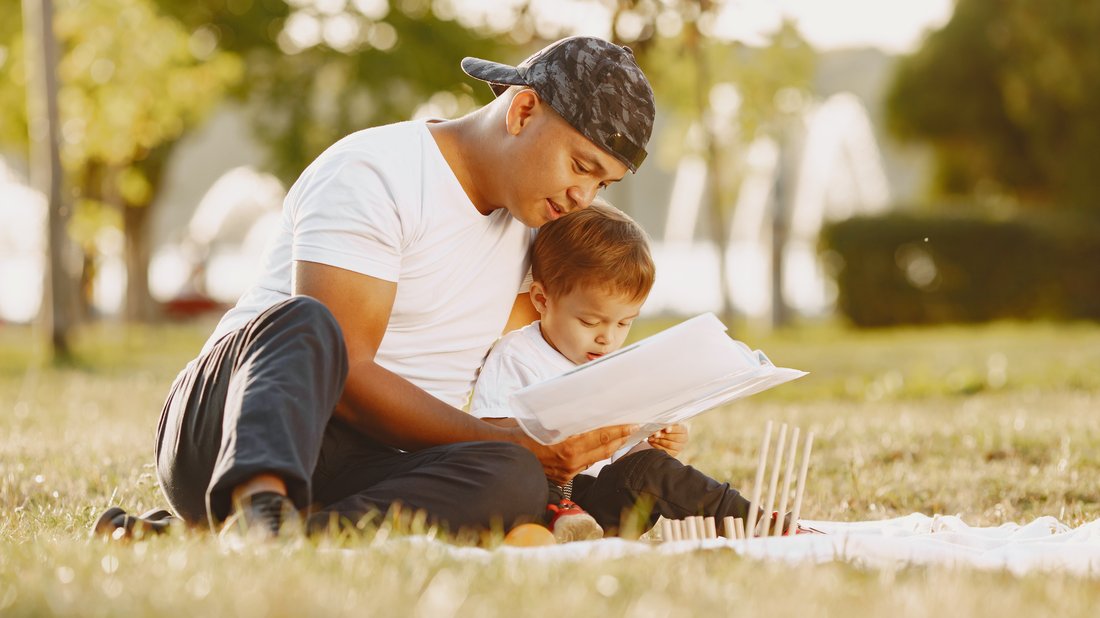
Somewhere tonight a four-year-old is going to hear the word bewildered. Nobody in that house will say it at breakfast. It will not come up in the car, at the park, or on any screen. A picture book is the only place that child was ever going to meet it, and that is the entire argument in one sentence.
Where uncommon words actually live
In 1988 Donald Hayes and Margaret Ahrens went hunting for rare words. They sampled language from across ordinary life, children talking to each other, adults talking to each other, children’s television, adult prime-time television, and children’s books, then counted how densely uncommon words appeared in each.
Print won. Television came close to last.
Rare words, ranked by where you find them
Hayes and Ahrens, Journal of Child Language, 1988
Density of uncommon words, richest first.
One correction, because this finding gets stretched. Picture books for preschoolers landed roughly level with college graduates talking to their spouses, so the accurate claim is that books match the richest conversation a child is likely to hear and comfortably beat anything with a screen attached.
The reason is mechanical. Speech does not need many words, because you have tone, gesture, a shared room and the option of pointing at the object. Writing has none of that. A writer who cannot point has to choose the exact word instead, which is why bewildered lives in books and confused lives in kitchens.
How a word gets learned, and how slowly
William Nagy, Richard Anderson and Patricia Herman ran the studies everyone quotes. In one, 352 children in third, fifth and seventh grade read passages from their own textbooks, then six days later were tested on the hard words those passages contained. Small gains appeared, reliably, at every grade and every ability level.
Small is the operative word. One meeting with a new word in a story leaves you with a fragment of it at best, and a meta-analysis by Swanborn and de Glopper confirmed that single-encounter gains are slight. Researchers generally reckon a word needs somewhere between eight and a dozen encounters before it is properly yours.
It also explains why the gap widens on its own. A child who reads easily reads more, meets more words, understands more of the next book, and reads more again. A child who finds it hard reads less, and nobody has to do anything wrong for the distance between them to grow every year.
What happens in a bilingual house
Here is the part that causes the most unnecessary worry, and it deserves the clearest explanation.
Bilingual children usually score lower than monolingual children on a vocabulary test in one of their languages, and often in both. This is measured, repeated, and entirely expected. It is also frequently misread.
Vocabulary in a bilingual child is distributed. Words get learned where they get used. Kitchen words attach to the kitchen language, school words to the school language, and the child ends up with a large number of what researchers call singlets, concepts they hold in one language only.
Singlets and doublets
Pearson, Fernández and Oller, and later work on conceptual scoring
A doublet is a concept the child can name in both languages. A singlet is one they can name in only one. Young bilinguals typically carry more singlets than doublets.
That last line is the one to hold onto. When researchers score conceptually, counting a concept as known if the child has it in either language, the cumulative vocabulary of bilingual children comes out equal to or larger than that of monolingual children.
The practical consequence is serious. Assessing a bilingual child in one language alone risks identifying a language impairment that is not there, and this over-identification is well documented in the literature. A child who cannot name a picture in English may name it instantly in Guaraní, Spanish or Hungarian.
Picture the room
A five-year-old is shown a card and asked what it is. She hesitates. In the language of the test she has nothing. In the language her grandmother uses in the garden she has the word, along with what the plant smells like, when it fruits, and who taught her. The score sheet records a blank.
One caveat that matters for school. Everyday conversational vocabulary and the vocabulary that carries academic work are different animals, and strength in the first does not guarantee the second in either language. That is an argument for reading widely in both, rather than for abandoning one.
The advantage nobody tells Spanish speakers about
Now the good news, and it is considerable.
English keeps two vocabularies. Everyday words tend to come from Germanic roots, while formal and academic words came in from Latin, mostly through French. Spanish took the same Latin words directly, and never demoted them.
The English words that make academic text feel difficult are, very often, ordinary Spanish words wearing a costume.
Academic English, everyday Spanish
Analysis of the Academic Word List and cognate research
A study of subtechnical vocabulary in adult texts found roughly two thirds of the words had Spanish cognates, and most academic cognates are more common in Spanish than in English.
A Spanish-speaking child reading English science already knows most of the hard words, in Spanish. What is missing is the link between them. Nobody has pointed out that comprehend and comprender are the same word, so the child meets comprehend on the page, decides it is unfamiliar, and either stalls on it or skips it, while the Spanish word that would have unlocked it sits unused.
Nagy, García, Durgunoğlu and Hancin-Bhatt tested this with bilingual students and found that the ones who recognized cognates comprehended English expository text better, and that stronger readers used cognates far more than weaker ones. Cognate awareness can be taught, and explicit teaching reliably improves it.
Two cautions to share with a child. Cognates look more alike than they sound, so the connection is easier to spot on the page than by ear. A handful are also traps: embarazada is pregnant, not embarrassed, and librería is a bookshop rather than a library.
Try this once: open any school science page with a bilingual child and ask them to hunt for words that look like Spanish. Once they have found six, they will not stop finding them.
The other habit that predicts vocabulary
Beyond volume, one skill keeps showing up in the research: noticing that words are made of parts.
A child who understands that un reverses, that pre means before, that bio is life and graph is writing, is not learning words one at a time any more. They are learning machinery. This morphological awareness predicts reading comprehension on its own, over and above how many words a child already knows, and it is precisely what makes cognates visible.
Other languages make this obvious in a way English hides. Arabic builds most words from three-consonant roots, so k-t-b gives kataba, he wrote, kitāb, a book, kātib, a writer, and maktaba, a library. Chinese combines characters, so electricity plus brain is a computer, and fire plus mountain is a volcano. Hungarian stacks endings onto a stem, turning ház, a house, into házaimban, in my houses, where each piece does a job English needs a separate word for.
English works this way too. It simply disguises it, because the parts arrived from three different languages and stopped looking related.
How this applies to you
- Volume beats difficulty. Pages read easily and enjoyed do more than pages read painfully. The mechanism is repeated exposure, and exposure needs quantity.
- Do not simplify as you read aloud. The unusual word is the reason the sentence exists. Read it as written.
- Define it in five words, then keep going. Stopping to teach kills the story, and the story is what makes the word memorable.
- Point at the picture instead of explaining. A creature standing frozen in the middle of chaos is bewildered. The word arrives with an image attached.
- Reread without apology. Encounters two through ten are where a half-known word becomes a known one.
- Use it yourself within a day. Retrieval fixes a word far better than recognition.
- In a bilingual home, read in both. Do not drop a language to strengthen another. The total is what counts, and the languages feed each other.
- Teach the hunt for cognates. It converts a perceived disadvantage into a genuine head start.
- Follow the obsession. A child deep in dinosaurs absorbs herbivore and cretaceous without noticing, because they want what the words carry.
Nobody in that house is going to say bewildered at breakfast. The book will say it tonight, and again next week, and one day the child will use it about the dog and everyone will wonder where it came from.
Sources and further reading
- Donald P. Hayes and Margaret G. Ahrens, Vocabulary simplification for children: a special case of “Motherese”?, Journal of Child Language, 15, 1988
- William E. Nagy, Richard C. Anderson and Patricia A. Herman, Learning word meanings from context during normal reading, American Educational Research Journal, 24(2), 1987, and Learning words from context, Reading Research Quarterly, 20, 1985
- Marja Swanborn and Kees de Glopper, meta-analysis of incidental word learning while reading, Review of Educational Research, 1999
- Barbara Zurer Pearson, Sylvia C. Fernández and D. Kimbrough Oller, Lexical development in bilingual infants and toddlers: comparison to monolingual norms, Language Learning, 43(1), 1993
- D. Kimbrough Oller, Barbara Z. Pearson and Alan B. Cobo-Lewis, on distributed vocabulary knowledge in bilinguals, Applied Psycholinguistics, 2007
- Research on conceptual scoring in bilingual vocabulary assessment and the risk of over-identifying language impairment, including work by Pearson and Fernández and by Bedore and Peña
- William E. Nagy, Georgia E. García, Aydin Y. Durgunoğlu and Barbara Hancin-Bhatt, Spanish-English bilingual students’ use of cognates in English reading, Journal of Reading Behavior, 25(3), 1993
- Shira Lubliner and Elfrieda H. Hiebert, An analysis of English-Spanish cognates as a source of general academic language, Bilingual Research Journal, 2011
- Averil Coxhead, A new Academic Word List, TESOL Quarterly, 34(2), 2000
- Keith E. Stanovich, Matthew effects in reading, Reading Research Quarterly, 21, 1986