Jessica Logan had a number she could not stop thinking about. In an earlier study she had found that roughly one quarter of American children in a national sample were never read to at home, and another quarter were read to once or twice a week at most. She and her colleagues at Ohio State called the finding shocking. Then came the harder question: what does that actually cost a child? To answer it, she needed to know how many words live inside a picture book, so she called a library.
A researcher, a library, and one hundred picture books
Logan's team worked with the Columbus Metropolitan Library, which pulled its most circulated titles for the youngest readers: the board books that go in a toddler's mouth as often as their hands, and the picture books that follow. The researchers counted the words in them. Board books averaged around 140 words. Picture books averaged about 228.
From there the arithmetic was simple and the result was not. Assuming board books for the first three years and picture books for the two after that, they calculated how many words a child would have heard by the time they walked into kindergarten.
Words heard from books by age five
Logan, Justice, Chaparro-Moreno and Yumuş, Journal of Developmental and Behavioral Pediatrics, 2019
The gap between the top and bottom of this ladder is roughly 1.4 million words, absorbed before a child has read a single sentence alone.
Logan has said the figure is almost certainly conservative. The count includes only the words printed on the page, and no parent reads that way. Real bedtime reading is full of interruption: naming the dog, asking what happens next, explaining what a lighthouse is, inventing a voice for the badger. Researchers call this extra-textual talk, and it stacks more vocabulary on top of the printed total.
A related figure needs a caveat. A 1990s study by Betty Hart and Todd Risley reported that children in the poorest homes heard some 30 million fewer words by age three than children in the most advantaged ones. That number traveled far and fast into policy. Later research has challenged its size, with some studies suggesting the gap is considerably smaller, and the Ohio State team acknowledged the dispute directly when publishing their own work. What makes the book-reading figure sturdier is its modesty: it counts printed words in specific, named books, and claims nothing beyond that.
Why the words in books are unlike the words in a kitchen
Household speech runs on a small, efficient core. Shoes, dinner, careful, tired, later. A picture book about a lighthouse keeper hands a four-year-old beacon, gale, anchor, drenched, and does it inside a story where the meaning is visible in the pictures and audible in an adult's voice. Logan's point was that a child who has heard those words has a place to put them when they later appear in print.
Picture the room
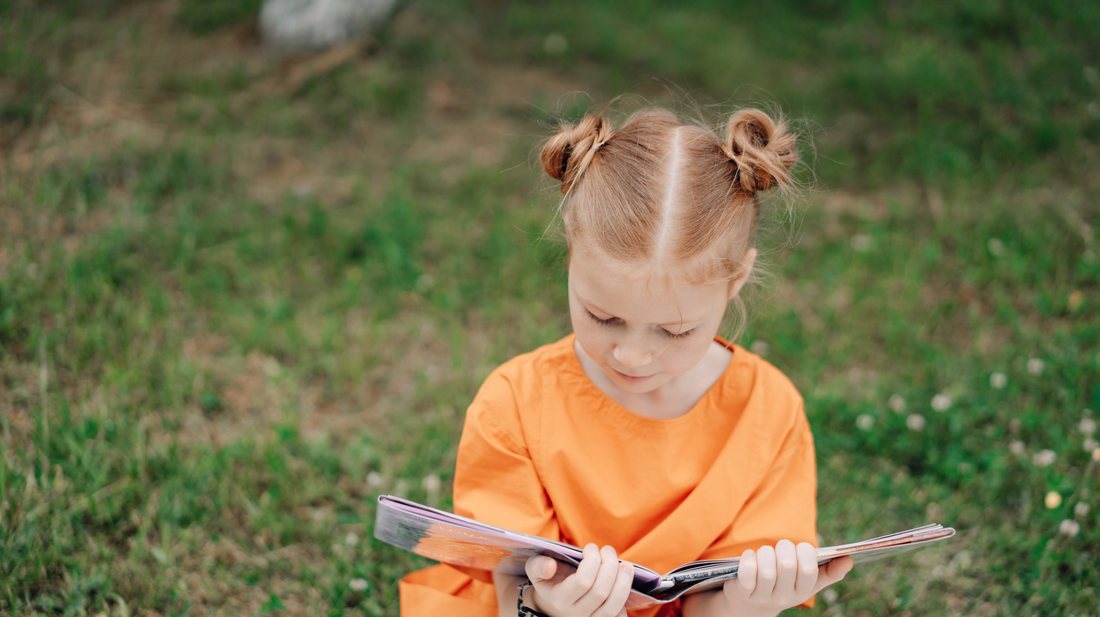
It is twenty past seven. The bath water is still draining somewhere behind the wall. A child who fought the pajamas for ten minutes is now perfectly still, one heel hooked over your knee, because the badger is about to open the door. You have read this book forty times. You know the last line by heart, and so does she, and she will say it with you. Nobody in this room is thinking about vocabulary acquisition.
The habit shows up again fifteen years later
Alice Sullivan and Matt Brown at the Institute of Education in London went looking for what happens after the picture books are outgrown. They used the 1970 British Cohort Study, which has followed thousands of people born in Britain in a single week of 1970, and analyzed the reading behavior of around 6,000 of them against test results in vocabulary, spelling, and mathematics at ages five, ten, and sixteen.
Children who read often at ten and more than once a week at sixteen scored higher on all three tests at sixteen than children of the same social background who had scored the same as them at five and ten. Reading was linked to progress in mathematics, which surprised people who assume reading is a language matter. The researchers tested playing a musical instrument as a comparison, and it showed no equivalent effect.
What the cohort data showed
Sullivan and Brown, British Educational Research Journal, 2015; Institute of Education, 2013
The comparison that startled the researchers involved parental education, usually one of the strongest predictors in the whole field.
Reading for pleasure mattered more to cognitive progress in adolescence than parental education did. For any parent who has ever felt underqualified to raise a reader, that is the finding to hold onto.
A country that gives its greatest storyteller a national day
On September 30, 1859, in the village of Kisbacon in Transylvania, Elek Benedek was born. He grew up in Székelyföld hearing tales told aloud, cut short his studies in Budapest to go collecting them with his friend Jób Sebesi, and published the result as a volume of Transylvanian folk tales. He spent the rest of his life gathering, retelling, and putting into print the stories of the Székely people. In 1889 he founded Az Én Újságom, the first Hungarian literary magazine for children, with the poet Lajos Pósa. Hungarians still call him Elek apó, and he is remembered as the country's great teller of tales.
In 2005 the Hungarian Reading Association proposed that his birthday become a magyar népmese napja, the Day of the Hungarian Folk Tale. Every September 30 since, thousands of tales are told aloud in libraries, kindergartens, and classrooms across Hungary and in Hungarian communities abroad. The day honors Hungarian folk tales and the tales of every other people alongside them.
The instinct behind that day is the same instinct behind bedtime reading in any language. A story told to a child is an inheritance handed over in person. The Hungarian appeal that launched the day described it as a satchel of treasure received from our ancestors, worth taking out, polishing, and passing on.
The cliff that arrives at age nine
Something happens to children and books around the third grade, and Scholastic has been documenting it since 2010 through its Kids and Family Reading Report. Researchers there named it the decline by nine.
What changes between eight and nine
Scholastic Kids and Family Reading Report, 7th and 8th editions
The drop does not recover. Later editions found the decline continuing steadily through adolescence rather than rebounding.
The timing is cruel. Third grade is the year the Annie E. Casey Foundation's research identifies as a hinge point, when reading proficiency becomes a strong predictor of later academic outcomes. It is also the year reading stops being a story on a lap and becomes an assignment with a worksheet attached. A child who has just gained the ability to read anything they want frequently discovers, in the same season, that reading has been converted into work.
What actually keeps a child reading
Across every edition of the Scholastic research, the same practical levers keep surfacing, and none of them require money or expertise.
- Let them choose. Children consistently report that their favorite books are the ones they picked themselves. The graphic novel you would not have chosen is doing more work than the prize-winner you would have.
- Keep books within reach. Access to books a child actually wants is one of the strongest predictors of how often they read. A library card handles this on any budget.
- Be seen reading. Having people in the household who visibly enjoy reading is among the biggest predictors of a child's reading frequency. Children calibrate to what adults do rather than what adults recommend.
- Read aloud past independence. The moment a child can read alone is the moment most families stop reading together, which removes the pleasure at precisely the age the data says pleasure collapses.
- Follow the obsession. Sharks, volcanoes, horses, ancient Egypt. A narrow, fierce interest is a reading engine, and it widens on its own.
- Protect it from becoming a chore. Reading logs, minute quotas, and required summaries teach a child that reading is something adults measure. Nothing in the research suggests that produces readers.
How this applies to you
The evidence points at something smaller and steadier than most parents expect. A few minutes most days, a child allowed to choose their own book, and an adult who reads where the child can see it. That is the whole apparatus, and it costs nothing beyond attention.
The cost of entry is a library card and the willingness to read the badger book for the forty-first time. What accumulates is a million words, a habit that outperforms a parent's degree, and a child who has somewhere to go on a bad afternoon for the rest of their life.
Sources and further reading
- Jessica A. R. Logan, Laura M. Justice, Melike Yumuş and Leydi Johana Chaparro-Moreno, When Children Are Not Read to at Home: The Million Word Gap, Journal of Developmental and Behavioral Pediatrics, 2019
- The Ohio State University, A "million word gap" for children who aren't read to at home, Ohio State News, April 2019
- Jeff Grabmeier, The importance of reading to kids daily, Ohio State College of Education and Human Ecology, April 9, 2019
- ScienceDaily, coverage of Logan et al., April 4, 2019
- Association of American Universities, featured research summary of the million word gap study
- Library Research Service, summary of the Ohio State word-exposure findings, July 2019
- Crane Center for Early Childhood Research and Policy, The Ohio State University
- Columbus Metropolitan Library, circulation data used to select the board books and picture books analyzed
- Betty Hart and Todd R. Risley, Meaningful Differences in the Everyday Experience of Young American Children, Brookes Publishing, 1995
- Helen Raikes et al., on maternal book reading at fourteen months predicting later vocabulary, 2006
- Alice Sullivan and Matt Brown, Reading for Pleasure and Progress in Vocabulary and Mathematics, British Educational Research Journal, vol. 41 no. 6, 2015
- Alice Sullivan and Matt Brown, Social Inequalities in Cognitive Scores at Age 16: The Role of Reading, Centre for Longitudinal Studies working paper, 2013
- Institute of Education, University of London, Reading for pleasure puts children ahead in the classroom, September 11, 2013
- UCL Centre for Longitudinal Studies, research briefing RB106 on reading for pleasure
- 1970 British Cohort Study (BCS70), funded by the Economic and Social Research Council
- Scholastic, Kids and Family Reading Report, 7th edition, 2019
- Scholastic, Finding Their Story: Navigate the World, on the decline by nine
- School Library Journal, Scholastic Survey Reveals Large Drop in Reading Between Ages 8 and 9, March 2019
- Scholastic, Kids and Family Reading Report, 8th edition, September 2023
- Scholastic, Reading in the Lives of Kids and Parents, key findings from the 8th edition
- Annie E. Casey Foundation, research on third-grade reading proficiency as a predictor of academic outcomes
- Wikipedia and the Hungarian National Széchényi Library calendar of notable days, on Elek Benedek (1859-1929), Kisbacon, and Az Én Újságom
- Magyar Olvasástársaság (Hungarian Reading Association), 2005 appeal establishing a magyar népmese napja on September 30
- nepmesenap.hu and Jeles Napok, Országos Széchényi Könyvtár, on the annual observance of the Day of the Hungarian Folk Tale