
In the Kalahari, an anthropologist named Polly Wiessner spent four decades listening to the Ju/’hoansi. She noticed something and decided to count it: what people talked about in daylight, and what they talked about after dark. The answer turned out to be two almost entirely different activities.
Daylight talk and firelight talk
Wiessner analyzed 174 conversations recorded between the 1970s and the 2000s, along with 68 translated texts, and published the results in the Proceedings of the National Academy of Sciences in 2014.
What changed when the sun went down
Ju/’hoansi communities, southern Africa
Daytime conversation was overwhelmingly practical, and where it was social it was mostly corrective: complaints, disputes, gossip that pressured people to behave. After dark, around fire, the subject changed almost completely.
The night stories were about past hunts, fights over meat, marriages and courtship customs, births, murders, bush fires, getting lost, dealings with distant groups, and, in later decades, trucks breaking down. Ordinary life, told back.
Notice what that combination does. The same group of people who spent the afternoon arguing about the division of meat spent the evening laughing at a story about somebody’s grandfather. The stories were doing repair work.
Picture the room
There is no room. There is a fire, and the dark past it, and eight or ten people who have been irritated with each other since midday. Somebody starts talking about a hunt that went wrong years ago. Within a minute the person who was angriest is the one laughing hardest. Nobody has apologized. The argument is simply over.
Storytellers were worth keeping
A related study of the Agta, a hunter-gatherer people in the Philippines, went further. Researchers led by Andrea Migliano found that camps with more skilled storytellers showed higher levels of cooperation, and that accomplished storytellers themselves had greater reproductive success than their peers.
Storytelling, in other words, was not a leisure activity that societies could afford once the real work was done. It looks like part of the machinery that made the real work possible, and being good at it carried a measurable advantage.
What happens between two brains
In 2010, three Princeton researchers put the question inside a scanner. Greg Stephens, Lauren Silbert, and Uri Hasson recorded a young woman telling an unrehearsed fifteen-minute story about her high school prom while an fMRI machine tracked her brain. Then they played the recording to listeners in the same machine.
They used the speaker’s brain activity to predict the listeners’ brain activity, and it worked. Patterns in the listener’s brain mirrored patterns in the speaker’s, running slightly behind hers as the story unfolded.
Two further findings sharpen it. Some regions of the listener’s brain did not lag behind the speaker at all; they ran ahead, anticipating what was coming, and the stronger that anticipation, the better the listener understood the story. Understanding someone is not passive reception. The listener is running the story slightly in front of the teller, and connection is what it feels like when the two predictions match.
The fire takes different shapes
Every culture that has needed people to stay bound together has built a version of that fire. Three of them are worth meeting directly.
The hakawati of Damascus
Al-Nawfara café, beside the Umayyad Mosque, Old Damascus
At eight in the evening the storyteller enters in traditional Damascene dress and a tarboush, climbs to a raised chair above the tables, opens a book, and reads one installment of an epic while striking the air with a sword or cane at moments of danger. Then he stops, mid-crisis, and everyone comes back tomorrow.
A serialized cliffhanger in a café is a machine for making people return to the same room night after night. During Ramadan the tradition revives: children sit cross-legged at the front, and the older listeners mouth along with passages they have known since childhood. A member of the family that runs the café put it simply, saying the storyteller was their old television.
That detail of the mouthing along is exactly what your family does when someone starts a story everyone has heard fifty times. Nobody stops them. The repetition is the point.
The yarning circle
Aboriginal and Torres Strait Islander communities, Australia
To yarn is to talk and share stories. In a yarning circle people sit facing one another with nobody at the head, and each speaks without interruption. Researchers distinguish social yarning, collaborative yarning where ideas are built together, and topic yarning aimed at a specific question.
Yarning is not only heritage. It is now the most recommended method for collecting information in Aboriginal and Torres Strait Islander health research, and Queensland schools use yarning circles in classrooms. A storytelling form judged strong enough to carry medical research and formal education says something about how well it works.
In West Africa, the griots hold a third version of the role. Women as well as men, carrying hereditary responsibility for genealogy and history, they keep the epic of Sundiata, who founded the Mali empire in the thirteenth century. A people’s record of itself, maintained in performance rather than in an archive, tying every listener to a line that reaches back centuries.
Damascus serializes to bring people back. Australia arranges the circle so nobody outranks anyone. West Africa makes one family responsible for remembering everybody. Three different engineering solutions to the same problem: how do you keep a group of people attached to each other?
Is there one story underneath all of them?
The most famous answer belongs to Joseph Campbell. In The Hero with a Thousand Faces, published in 1949, he argued that myths from every part of the world follow a single underlying pattern, which he called the monomyth, borrowing the word from James Joyce. A hero leaves the ordinary world, is tested in a strange one, and returns carrying something the community needs. Separation, initiation, return.
Campbell reached an enormous audience, especially after his 1988 television conversations with Bill Moyers, and he sent several generations of readers to mythologies they would never otherwise have opened.
Folklorists have spent decades objecting, and their objection matters here, because it bears directly on everything above.
The case against the monomyth
Folklore and anthropology, from the 1980s onward
The charge is not that Campbell found nothing. It is that he found it by choosing what to look at, and that flattening the differences destroys the meaning the stories carry in the places they come from.
Toelken’s example is the sharpest. He pointed to Indigenous narratives in which the culture is not renewed at the end but destroyed, stories that cannot be made to fit a shape where the hero returns with a boon. A pattern that requires you to ignore those is a pattern you have partly built. The anthropologist Donald Consentino put the risk memorably, warning against a Campbell soup of myths in which all the local flavor is boiled away.
Set that beside the hakawati, the yarning circle, and the griot. Those three are not variations on one story. They are three distinct technologies, each engineered for a different social problem, and the differences are precisely where the intelligence lives.
The better answer
Campbell asked whether all stories share a plot. The evidence in this article suggests a different question was the right one all along.
What the Ju/’hoansi fires and the Princeton scanners point to is not a common story but a common effect. Stories gather attention onto one point. They put listeners inside a simulation and run everyone’s version of it in near-lockstep. They let a group repair itself without anyone having to apologize. They carry people who are not in the room.
None of that depends on the plots matching. A Damascene epic about a thirteenth-century sultan and a story about your grandmother burning the dinner do entirely different narrative work, and both produce the same coupling between the teller and the people listening.
Why this feels like closeness
Set the two lines of evidence beside each other and the mechanism is not mysterious.
- Shared attention. For the length of a story, a group shares one focus. That is rare, and it is the precondition for everything else.
- Shared interior. Listeners are not receiving a report; they are running a simulation, and running the same one as everyone else present.
- Safe distance. A story about somebody else’s bad decision can be discussed without anyone having to defend themselves. Wiessner’s rifts healed because nobody had to admit anything.
- Reach beyond the room. Firelight talk was largely about people who were not there, which is how a small group stays connected to a much larger network.
The version of this you already own
Every family runs a private canon: the account of how your parents met, the disastrous holiday, the relative who said the unforgivable words at a wedding. These are told and retold with the same phrases, and everyone tolerates the repetition, because accuracy was never the point. The telling is a membership ritual. Knowing the stories is what makes someone family rather than a guest.
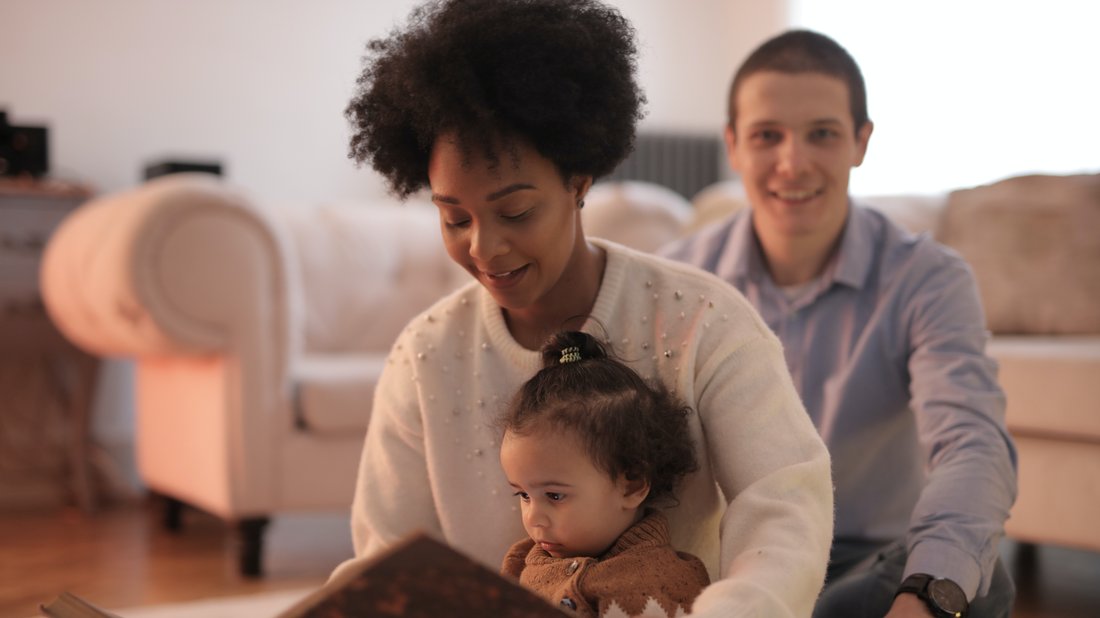
The same is true of a book read to a child forty times. The child is not seeking information. They are asking for the specific experience of you, that voice, those pauses, in the usual place, again.
How this applies to you
- Protect the evening. The Ju/’hoansi finding is that connection talk happens at a different hour from logistics talk. A household that only ever discusses schedules is having daytime conversation all day.
- Tell the failures. The stories that bound Wiessner’s groups were largely about plans going wrong. Competence impresses; disaster connects.
- Repair sideways. After a hard day with a child, a story often works where a conversation about behavior will not.
- Repeat without embarrassment. Retelling is not a failure of imagination. It is how a group confirms who it is.
- Talk about people who are absent. Grandparents, ancestors, old neighbors. That is how a child inherits a network larger than the house they live in.
Fifty thousand years of this happened before anyone wrote anything down, around fires, at the end of days that had often been difficult. The technology has changed. A book at bedtime is a fire with better lighting.
Sources and further reading
- Polly W. Wiessner, Embers of society: Firelight talk among the Ju/’hoansi Bushmen, Proceedings of the National Academy of Sciences, 111(39), 2014
- Robin Dunbar, How conversations around campfires came to be, commentary in PNAS, 111(39), 2014
- University of Utah, Firelight talk of the Kalahari Bushmen, summary of the study’s findings
- Daniel Smith, Philip Schlaepfer, Andrea Migliano et al., on storytelling, cooperation, and reproductive success among the Agta of the Philippines
- Greg J. Stephens, Lauren J. Silbert, and Uri Hasson, Speaker-listener neural coupling underlies successful communication, Proceedings of the National Academy of Sciences, 107(32), 2010
- Uri Hasson, Princeton Neuroscience Institute, lectures and papers on shared neural responses during storytelling
- Asieh Zadbood et al., How We Transmit Memories to Other Brains, Cerebral Cortex, 27(10), 2017
- Arab America, Storytelling at the Al-Nawfara Coffee-House, and Gulf News, A revival of tradition, on the hakawati of Damascus
- Syrian Arab News Agency, In Damascus, a Ramadan storyteller keeps a fading tradition alive
- Stuart Barlo, William Boyd, Alessandro Pelizzon, and Shawn Wilson, Yarning as Protected Space: Principles and Protocols, AlterNative, 2020
- Dawn Bessarab and Bridget Ng’andu, on yarning as a research method, and the Queensland Curriculum and Assessment Authority guidance on yarning circles
- Joseph Campbell, The Hero with a Thousand Faces, 1949
- Alan Dundes, Presidential Plenary Address to the American Folklore Society, Journal of American Folklore, 118(470), 2005
- Barre Toelken, The Dynamics of Folklore, revised edition, Utah State University Press, 1996
- Lesley Northup, Myth-Placed Priorities: Religion and the Study of Myth, Religious Studies Review, 2006, and Marta Weigle on gender in the monomyth